
PO'PAY, THE PUEBLO REVOLT OF 1680
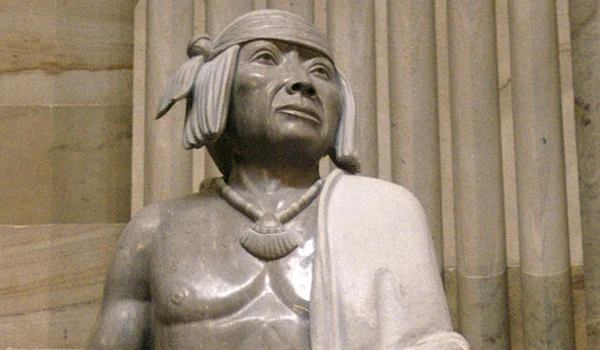
The statue of Ohkay Owingeh religious leader Po’Pay, by Jemez Pueblo artist, Cliff Fragua, in the Rotunda of the U.S. Capital. Photograph by Chris Maddaloni/Getty Images
Po'Pay, The Pueblo Revolt of 1680
August 10, 2026 | Native Children's Survival
Po'Pay, an Ohkay Owingeh framer and Tewa religious leader, was born around 1630 in the place of the strong people during the Spanish colonization of what is now known as New Mexico.
While the European invasion commenced when Christopher Columbus embarked on a voyage from Spain on 3 August 1492, in search of India, he inadvertently landed on the shores of Indigenous Peoples. The Spanish conquest that followed, was brutally inhuman, accompanied by an insatiable pursuit of gold.
Religious persecution and violent encounters, such as the Acoma Massacre in 1599, became unbearable, leading to growing animosity towards Spanish settlers. Nearly two centuries of attempted genocide, slavery, and efforts to convert Native Peoples to Christianity took its toll. By the 1600s, in the southwest Indigenous territories, Pueblo Nations suffered under Spanish rule. Pueblo culture was on the verge of being destroyed and lost forever. Those found practicing their spiritual ceremonies were persecuted, tortured, and even killed.
In 1675, Tewa leader Po'Pay and 46 other Pueblo leaders were arrested for their spiritual practices and were convicted of sorcery. Many were flogged, and some were executed. Po'Pay was among the survivors. Upon his release from prison, Po'Pay moved to Taos Pueblo. From there, he united the Pueblos in a secret rebellion against the Spanish empire.
On 10 August 1680, with the help of neighboring Indigenous allies, the Pueblo Revolt began. When it was over, the Spaniards were driven out, and those who had sought refuge were allowed to leave. The 1680 Pueblo Revolt was the first successful uprising by Native Nations against a colonial power. Po'Pay's leadership and the Pueblo Revolt helped to ensure the Pueblo Nations' cultural survival and religious and ceremonial practices.
A statue of Po'Pay carved from pink marble by Jemez Pueblo artist Cliff Fragua was given to the National Statuary Hall Collection in 2005 by the State of New Mexico. The figure stands in Emancipation Hall, U.S. Capitol Visitor Center. Of the seven statues that honor Native Peoples, Po'Pay is the only one carved by an Indigenous sculptor.
In the Spirit of Po'Pay, join us in the Pueblo tradition of resisting the forces that threaten Indigenous Peoples, Mother Earth, and All Our Relations.